

Guides
Holding and Several GmbHs at One Address in Germany
Can a holding and several GmbHs share one address in Germany? What the law requires, tax residency, costs and how to set it up.

Emily Schreiber
September 30, 2026
Impressum in English isn't Imprint, it's Legal Notice. What German law requires, and how to protect your address.
Quick answer
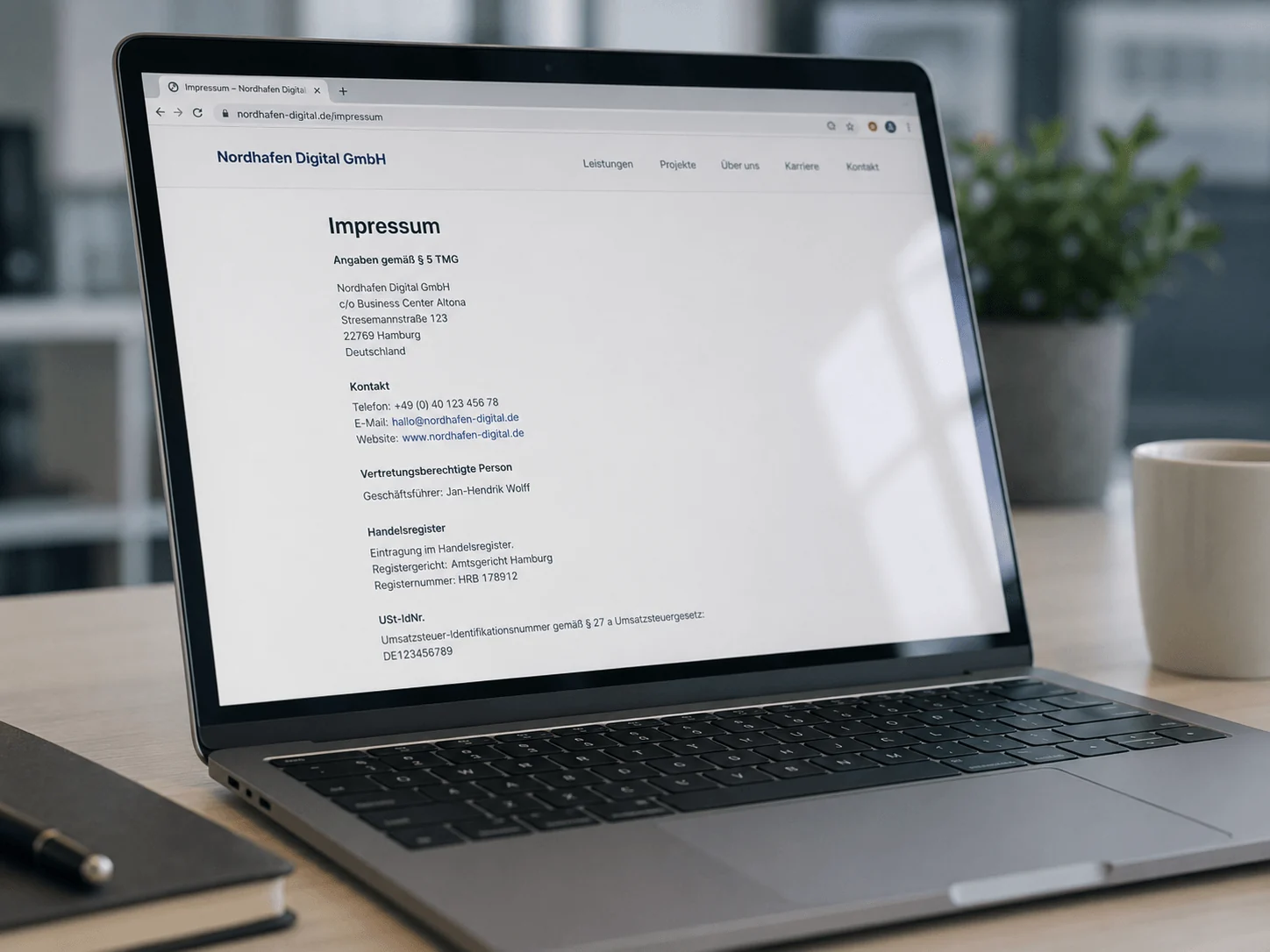
"Impressum" doesn't translate to "Imprint." The accurate English term is Legal Notice (or Legal Disclosure). If your business is based in Germany and you run a website, shop, or business social media account, the law requires it under Section 5 of the Digital Services Act (DDG, formerly the Telemediengesetz/TMG) — and that duty applies no matter what language your site is in. If your content targets English-speaking customers, publish an English version people can actually read. It needs your full name, a verifiable business address, an email plus one more fast contact channel, and your VAT ID or Wirtschafts-ID if you have one. Skip the tax number. Missing or incomplete information can mean a fine of up to €50,000 under Section 33(2) DDG, and more realistically, a competitor's cease-and-desist letter.
What you'll learn in this article
If you searched for "Impressum in English," you've probably already hit the problem: the word doesn't cleanly translate, half the internet tells you to use "Imprint," and none of that explains what the page is actually supposed to say or whether you even need one. Here's the short version: it's a legal disclosure page, German law requires it if you're running a business from Germany, and it needs to work the same whether it's in German or English.
No, and this trips up more site owners than you'd think. "Impressum" comes from Latin and has no exact one-word English equivalent. "Imprint" is the literal translation, but in English that word means a physical mark pressed into something, or a publishing house's brand name. It doesn't mean "legal disclosure," which is the actual function of the page.
The terms that actually match the German legal concept are Legal Notice, Legal Disclosure, or Site Notice. These line up with the language used in the EU's E-Commerce Directive, which is the underlying framework Germany's disclosure rules implement. If you're building a bilingual site, label the English version "Legal Notice," not "Imprint" — it's both more accurate and what an English-speaking visitor will actually understand as a legal disclosure page.
These get bundled together constantly because most sites publish both, but they answer different legal questions and neither substitutes for the other.
| Impressum (Legal Notice) | Privacy Policy | |
|---|---|---|
| Answers | Who runs this site, and how do I reach or sue them? | What data does this site collect, and what happens to it? |
| Legal basis | Section 5 DDG (Germany), EU E-Commerce Directive | GDPR (EU-wide) |
| Core content | Name, address, contact, VAT/W-IdNr | Data collected, purpose, storage, third parties, user rights |
| Who needs one | Any commercial digital service run from Germany | Any site processing personal data, EU-wide |
Yes. Section 5 DDG attaches the obligation to the operator, not the language of the site. If your business is established in Germany and you offer a commercial, ongoing digital service — a website, an online shop, a paid app, a monetized blog, a business social media profile — you need a compliant legal notice, whether the site is in German, English, or both. Running your whole business in English doesn't exempt you.
What does matter for the language question is your audience. If your site or shop targets English-speaking customers, an English legal notice isn't just good practice, it's the only way the disclosure actually serves its purpose: letting a visitor identify who they're dealing with and how to reach them. If you serve both German and international customers, keep both language versions and link to each from every page, reachable in no more than two clicks.
None of this depends on your revenue, whether you've registered a trade (Gewerbeanmeldung), or whether you're a freelancer, sole trader, or small GmbH. A side project with zero income is still covered if it's a sustained, ongoing offer. The only real exemption is a purely private page with no commercial angle at all — a hobby blog, a family site. For the full breakdown of what the law requires across websites and social media profiles, see our detailed guide.
Not really, and this is what confuses a lot of US-based readers. There's no single US law that requires a general-purpose legal disclosure page listing your name, address, and contact details on every commercial website. What US businesses deal with instead is more fragmented: state-level requirements to name a registered agent when incorporating, general Terms of Service and Privacy Policy pages, and sector-specific disclosure rules (financial services, healthcare) rather than one universal page.
The distinction that matters: the Impressum duty is tied to where the business operates from, not where its customers are. A US company with no establishment in Germany doesn't need one. But a business established in Germany selling to US customers in English does — the obligation follows the operator, not the market.
Section 5(1) DDG lists eight categories. For a sole trader or freelancer, only the first two are always mandatory — the rest apply depending on what you do.
Full name and a verifiable business address
Your full first and last name, written out (no initials, no username or pseudonym alone). Plus street, number, postal code, city. A PO box doesn't count, because the point is that court documents can actually reach you there.
Email address plus one more fast contact channel
An email address is explicitly required. Beyond that, the law asks for a way to make contact quickly and communicate directly — more on what that means (and whether it has to be a phone number) below.
VAT ID or Wirtschafts-Identifikationsnummer, if you have one
Required only if you actually hold one. Small businesses under Germany's VAT exemption (Kleinunternehmerregelung) often don't have a VAT ID — but may still need to list the newer Wirtschafts-ID. Full breakdown below.
Chamber and professional title, for regulated professions
Applies to tax advisors, architects, physiotherapists, and similar. State the chamber, your legal professional title, the country where it was granted, and the applicable professional regulations. Licensed activities also need the supervisory authority listed.
Example: freelancer with a VAT ID
Legal Notice (Impressum) pursuant to Section 5 DDG
Maria Beispiel
Musterstraße 12
10435 Berlin, Germany
Contact
Email: contact@beispiel.de
Phone: +49 30 12345678
VAT Identification Number
DE123456789
Example: small business without a VAT ID
Legal Notice (Impressum) pursuant to Section 5 DDG
Jonas Muster
Beispielweg 4
10435 Berlin, Germany
Contact
Email: hello@muster-example.de
VAT Identification Number
Not applicable, small business exemption under Section 19 UStG
Wirtschafts-Identifikationsnummer: DE123456789-00001
Most Impressum templates online are written for GmbHs. As a freelancer or sole trader, that means you often end up copying lines that don't apply to you — and occasionally, information that actively works against you.
Your tax number
Not required, and a real risk. A German tax number (Steuernummer) isn't a public identifier — anyone who has it can attempt to use it to request information about you from authorities. Section 5 DDG doesn't ask for it. Same goes for your personal tax ID (Steuer-ID).
Commercial register entry and number
Only applies if you're actually entered in the Handelsregister. As a sole trader or freelancer, you typically aren't — so leave the line out entirely. A made-up or copy-pasted register number from a template is a false statement, not a harmless placeholder.
The small-business VAT notice
A statement like "small business per Section 19 UStG" belongs on your invoices, not your legal notice. It's a VAT election, not a legal structure. You can add it voluntarily to head off questions about a missing VAT ID, but it isn't a requirement here.
A PO box, or any address nobody can find you at
Section 5(1) No.1 DDG requires the address where you're actually established. The point is that mail and court documents can reach you. A PO box doesn't meet that bar.
Not sure which entries your setup requires? Our overview of business legal forms in Germany breaks down what changes once you move from sole trader to UG or GmbH — at that point your legal notice needs a lot more: entity type, authorized representative, and full register details.
This is the part most English-language guides on this topic still get wrong, because it's recent. The old advice was simple: no VAT ID, no line needed. Since Germany introduced the Wirtschafts-Identifikationsnummer (business identification number, often shortened to W-IdNr), that's no longer the full picture.
Section 5(1) No.6 DDG asks for the VAT ID or the Wirtschafts-ID, whichever you have. If you already list a VAT ID, you don't need to add the W-IdNr as well. But if you're a small business without a VAT ID and you've been assigned a W-IdNr, that number now has to appear in your legal notice.
The number is based on Sections 139a and 139c of Germany's Fiscal Code (Abgabenordnung) and has been rolled out automatically by the Federal Central Tax Office (Bundeszentralamt für Steuern) since November 2024 — you don't apply for it. It's formatted as "DE" plus nine digits plus a five-digit sub-number, for example DE123456789-00001. Check whether you've received one via a notice from the Bundeszentralamt or your ELSTER account.
No phone number is named in the statute. Section 5(1) No.2 DDG asks for information that allows fast electronic contact and direct communication, including an email address — but it doesn't specify how. The European Court of Justice ruled on this directly on 16 October 2008, in Case C-298/07: a phone number isn't strictly required, provided another channel enables fast, direct, and efficient communication.
The case in question involved a contact form with a reply time of a few hours, which the Court accepted. It added one condition: if a user has no access to electronic communication after making contact, a non-electronic channel has to be offered too.
In practice: you're not legally forced to publish a personal mobile number. But going without a phone line is only safe if you genuinely respond fast to emails and form submissions — competitors looking for a cease-and-desist opportunity test exactly this. If you'd rather not have the discussion at all, use a dedicated business number instead of your personal one.
This article is a general overview and not legal advice. We can't and don't provide advice on individual cases. What your specific legal notice needs to include depends on your activity, your legal structure, and where you publish. If you've received a cease-and-desist letter or work in a regulated profession, talk to a lawyer specializing in German internet law (IT-Recht).
Two separate things can happen, and the second is far more common than the first. Under Section 33(2) DDG, a missing, incorrect, or incomplete legal notice is an administrative offense (Ordnungswidrigkeit), carrying a fine of up to €50,000. In practice, regulators rarely go looking for individual violations on their own.
What actually happens far more often is a cease-and-desist letter (Abmahnung) from a competitor or a trade association, triggered the moment they notice your page is missing information. That letter arrives with a lawyer's fee attached, whether or not it ever reaches a court, plus a demand that you sign a legally binding statement to fix it and never repeat the violation. It's a routine, high-volume enforcement pattern in Germany precisely because a missing or sloppy Impressum is one of the easiest things to spot on a competitor's site.
Step three is usually the one that actually stalls people, so it gets its own section below.
This is where the requirement gets uncomfortable for most solo founders. If you work from home and don't have an office, you're stuck choosing between two bad options: put your home address online for anyone to see, or skip the legal notice entirely. The second isn't really an option, and the first has real consequences.
Once it's published, your address sits permanently on your site, in legal-notice databases, in search engines, and on every marketplace profile you run. Address-scraping services pick it up, it ends up cited in cease-and-desist letters sent to you, and anyone you have a dispute with knows exactly where you live. That's a genuine problem if you have public-facing clients, work as a creator, or handle sensitive subject matter.
A rented business address solves this, on one condition: it has to be a verifiable, court-reachable address (ladungsfähige Anschrift). Mail and legal documents actually need to reach you there. That's the line between a real business address staffed by an actual team and an anonymous mailbox or PO box — if nobody's there to accept the post, the address doesn't hold up legally.
If you later register a UG or GmbH, the same address carries over for your commercial register entry and registered office (Handelsregister/Firmensitz) — you don't need to set up a separate arrangement later.
Your legal notice, without your home address
A court-reachable Berlin business address with a real team on-site to receive your mail. Active in five minutes, cancel monthly.
Teeberg is based at Kollwitzstraße 76 in Berlin Prenzlauer Berg — not an anonymous mailbox, but real office space with a team that accepts your mail. For a legal notice, you need an address that holds up as your official business address.
Postal Address
from €28/month
A business address for receiving and physically forwarding your mail. Suits solo founders who just need a credible address.
Virtual Office most chosen
from €63/month
Official business address for your commercial register entry and legal notice, daily court-admissible mail scanning, an office room on demand, plus mail receipt and storage.
All Inclusive Virtual Office
from €239/month
Everything in Virtual Office plus 4 hours of meeting room use per month and your own Berlin phone number — useful if you'd rather not publish a personal number either.
* Prices for annual billing, plus VAT, as of 2026. Monthly billing available.
Further reading
No. "Imprint" is the literal word-for-word translation, but in English it refers to a physical mark or a publisher's brand, not a legal disclosure. The accurate terms for what a German Impressum actually is are Legal Notice, Legal Disclosure, or Site Notice, which line up with the language used in the EU's E-Commerce Directive.
An Impressum (Legal Notice) discloses who operates the site and how to contact or take legal action against them, required under Section 5 DDG. A Privacy Policy discloses what personal data the site collects and how it's used, required under the GDPR. Most commercial sites need both, and they serve different legal purposes.
Yes. Section 5 DDG attaches the obligation to the operator being based in Germany and offering a commercial digital service, not to the language the site is published in. Running your business entirely in English doesn't remove the requirement, it just means your legal notice should be in English too, so it actually serves its purpose.
Not directly. US law doesn't require a universal legal-disclosure page. Instead, US businesses deal with state-level registered-agent requirements, general Terms of Service and Privacy Policy pages, and sector-specific disclosures. The Impressum obligation is tied to being established in Germany, not to who your customers are, so a US company with no German establishment doesn't need one.
At minimum: your full name, a verifiable business address where mail and legal documents can reach you, an email address plus one more fast contact channel, and your VAT ID or Wirtschafts-ID if you have one. Regulated professions add chamber and licensing details. Leave out your tax number, and skip the commercial register line unless you're actually registered.
Only if you have one. Section 5(1) No.6 DDG asks for a VAT ID or a Wirtschafts-Identifikationsnummer, whichever applies. Small businesses without a VAT ID should check whether they've been assigned a Wirtschafts-ID since November 2024, if so, that number needs to appear in the legal notice.
Not necessarily. The European Court of Justice ruled on 16 October 2008 (Case C-298/07) that a phone number isn't required if another channel, like a contact form with a fast reply time, allows quick and direct communication. That's only safe in practice if you genuinely respond fast. A dedicated business number avoids the question entirely.
Two things, in practice mostly the second: Section 33(2) DDG allows a fine of up to €50,000 for a missing or incomplete legal notice, but regulators rarely enforce this proactively. Far more common is a cease-and-desist letter (Abmahnung) from a competitor, which carries real legal fees and a demand to sign a binding statement, regardless of whether it ever reaches court.
Yes, as long as the address is court-reachable. Section 5(1) No.1 DDG requires the address where you're established, so that mail and legal documents can actually reach you. A PO box doesn't meet that bar. A staffed business address that accepts your post on your behalf does.
In a 15-minute phone call, we'll answer all your questions and gladly guide you through the steps to your Virtual Office.
Kostenlos & unverbindlich · 15 Minuten · Direkt mit Moritz